

A European Championship to Remember: The Story Behind Grandtully 2026

By The WWR Community
Grandtully hosted this years European Junior and U23 Wild Water Racing Championships from the 12 – 15 August.
Without a doubt these championships were seen as a huge success by the 197 competitors from 19 European Countries, who competed in the sunshine and with good river levels not only for the competition, but for the training days leading up to the event.
Clearly the river gods were smiling on us that week!
Wildwater Racing has two formats, the Classic Race, which takes around 17 minutes to complete the course and the Sprint Race which for this race took around 90 seconds.
We spoke to many of the folks involved to get their impressions of the event, from athletes to coaches to organisers to Paddle Scotland. Here’s what they had to say.
Morna Campbell – GB Coach
Morna, how did Scotland end up hosting the 2026 European Junior and U23 Wildwater Racing Championships?
The simple answer is through the perseverance of committed WWR volunteers in Britain!
We first thought about hosting this event in early 2025, as WWR has been going from strength to strength over the last decade, and it was about time we hosted our own championships. The UK WWR committee had hosted successful ECA (low level internationals) races in 2024, so we knew it was possible, and we knew there had been no bid yet for the 2026 junior Europeans. Grandtully would be the perfect race for a world class international due to the challenging sprint course in Grandtully rapid, and the dynamic classic course made up of 8 rapids. So, we proposed this idea to Paddle Scotland and Paddle UK, who both said no……
Fast forward to July 2025 when we were out in Solkan, Slovenia competing at Britains most successful junior and U23 world championships – all the other team managers/coaches were asking enthusiastically if it was true an event was coming to Scotland, and what the rivers were like. Disappointingly we had to tell them, not yet, we didn’t have approval. However, this enthusiasm from the other teams hit the British team coaches/volunteers and motivated us to push the powers at be to reconsider – and well, the rest is history
What does it mean to Wildwater racing in Scotland to have this event?
Hosting an international event on our local training ground means everything to our small sport. Knowing it was coming motivated existing athletes to try their very hardest to get in the team as they knew there would be that home advantage when it came to competing. Additionally, it brought new paddlers into WWR from other disciplines to try out for the team – particularly new junior athletes, with 5 new paddlers making junior team GB.
Hopefully we can carry a legacy from this event to continue to build WWR in Scotland and open it up to new paddlers. Although it is a competitive discipline, we welcome people of all ages and abilities and there is no need to compete – just the ‘want’ to go for a paddle in the river, learn new skills and have a good time!
Jamie Christie – GB Team Manager
Jamie, tell us how the planning and preparation went for this event?
Preparation started as soon as we had managed to convince Paddle Scotland and Paddle UK that volunteers could deliver a major international event in the UK at no cost to Paddle Scotland or Paddle UK. Davie Campbell came on board as event lead and started to organise everything for the event, it soon became evident with Davie’s enthusiasm, boundless energy and organisation that a great event was going to happen. From a GB team perspective, we wanted to field a team in every category (K1, C1 and C2) across both the Junior and U23 age categories. This meant we needed to encourage some young paddlers into the sport of Wildwater, get them up to speed in order to meet the selection requirements for making the GB team. This required more races, more training camps and more coaches and many weekends away going to races introducing paddlers around England and Scotland to Wildwater Racing.
I am very pleased to say we managed to select 30 athletes to compete in the championships in every class at the event, one of whom was still 14 years of age and others in their last year of U23. The standout statistic is we won 9 medals and 14 young paddlers almost 50% of the team walked away with a medal around their neck!!! Absolutely incredible.
What convinced you that Grandtully would make a good venue for these Championships?
Grandtully has everything needed to test a Wildwater paddler, sections of flat water to test speed and aerobic fitness, dispersed with a variety of rapids, some with waves, some small and shingly, some with tight technical lines which builds into Tully rapids which are technical and require precision paddling and finally Forth Falls which can catch even the most experienced paddle out.
How worried were you about river levels in the run up to the event?
When we decided to host the championships last year, I had no doubts, there is always a line down Tully. However as heat wave after heat wave arrived in the UK and zero rain it did start to become a real concern as the event drew closer. Fortunately, in rained for a couple of days the week before the event and this took the river to a perfect level for racing, and remained that way for the full Championships!
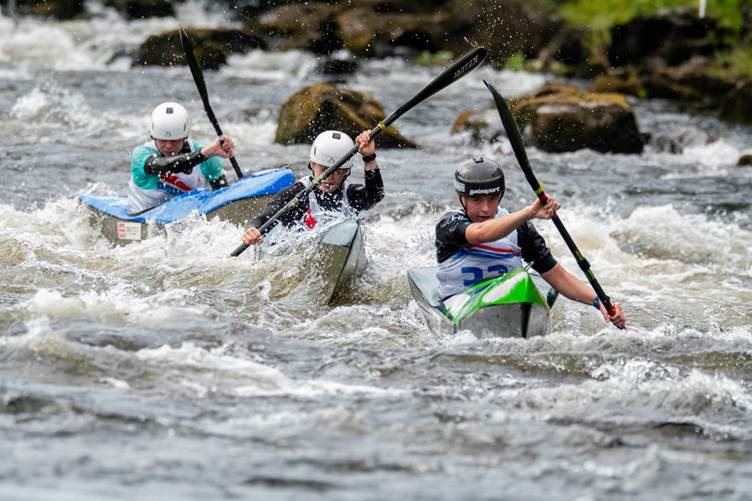
(K1W U23 team, Kerry Christie, Emma Christie and Freya Pryce)
Freya Price – GB Athlete
Freya, you had an incredible championships, tell us how you prepared for this event?
As soon as it was confirmed Grandtully would host the championships, the main goal was to know the river inside out. This involved as much Tully training as possible, at as many different river heights as I could, which is something which I am always more than happy to do! The GB team had the unique chance to get in lots of rest the week before racing, when usually this period would be spent doing endless runs of the river, finding, learning and perfecting the fastest lines. I felt much more prepared than usual, knowing I’d done all I could on the flat, I knew the river like the back of my hand, and was ready to paddle as fast as I could.
What was it like to compete at a European Championships on your home river?
It was incredible. I’ve always felt at home on the Tay and I have a smile on my face every time I paddle Tully. I have so many special memories there, from slalom training and racing, to my very first Wildwater race, to flying over the waves in really high water. It was unbelievable to have friends, family, and so many supporters from the paddling community on the sidelines cheering me on.
You won an individual silver, and gold and bronze in the teams events, this makes you the best Scottish Wild Water Racer of your generation, how does that feel?
Unreal, the championships were so much fun start to finish. The whole kayaking community is such a special one and has given me so much. I would not be on the water at all without countless people who have supported me, volunteer coaches who have given endless weekends of their time, paddlers and parents who have given me lifts all over the country, and other paddlers who have encouraged and supported me, and made training so fun. It’s so exciting to see plenty of new Scottish WWR talent emerging – lots of juniors raced internationally for their first time at Tully, so hopes are high for many more Scottish medals to come.
Eddie Mackintosh – GB Athlete
Eddie, tell us how the team performed overall
Throughout the run up to the racing the team performed very well aided by the multiple camps the preceding 4 weekends, I think that this preparation was invaluable to the newer members of the team. I was particularly impressed by some of the junior MK1 who had made great improvement since selection in April . During the final week I felt that everyone trained as a team and everyone understood what was required of them to get their best result. The allocation of coaching was particularly good, meaning that each group of paddlers could get directed input from a specific coach who could track their improvement.
Racing arrived and as usual brought with it some very long days but these were well organised with multiple shuttles running back and forth from the start finish and accommodation. There was a good camaraderie between the GB paddlers which helped with some of the emotions attached to race day. Coming up to the sprint finals day I think that everyone was able to deliver one final good minute of racing. The development of the canoe classes cannot be understated with almost complete rosters across C1s and C2s giving additional medal opportunities which were nice to celebrate.
Whats your best non-racing memory?
My favourite on-water, non-racing memory was the team training days. Paddling as a team is a totally different challenge and learning to gain off washes is a very difficult challenge and still needs more work. Seeing the improvement especially of the C2 team was very rewarding. Off the water the best times were having tea in the Moness courtyard with the rest of the team and getting to chat about both canoeing and non-canoeing life.
These Championships run on your home river has been a huge success, what do you think the impact will be on GB River Racing?
I think that this event will have an absolutely and completely positive impact on the GB wild water community. 29 British athletes attended this championship. I believe that every single one will remember the event and want to come back for more. Seeing the international community descend on Grandtully was inspiring and felt very surreal. I noticed that more content of the venue was posted on social media than at any other championships I have attended, this is a testament to the beauty of Grandtully and the excitement of the international community to race in the UK. Kick the Waves, the Czech WWR boat manufacturer, really did some impressive videos, so if you havn’t seen them check them out on the likes of Instagram. I think for many of the new British paddlers who have seen this community will be encouraged to return and race internationally next season.
It is also proof that the UK can have the depth of knowledge and competent volunteers to run a successful international championships and I hope it serves to open up the conversation around senior championships as well as returning to other classic courses such as Bala.
Sally Atkinson – Volunteer Team Lead
Sally, there were over 60 volunteers at these championships, how varied were your group of volunteers?
Volunteers ranged from parents or supporters of paddlers to people who knew nothing about the sport. It was great to see some youngsters volunteering who live relatively locally who are keen to contribute to the local community events.
What is your big memory of the event?
Big memory of the event was that it was very friendly and very well organised with everyone working together to make it the best event we could for the athletes. And that was the focus, how good can we make it for the athletes, no egos from the volunteers. It was lovely working with them all
Now be honest, did the volunteers enjoy their time at Tully?
I reckon the volunteers really enjoyed the experience probably as they worked so well together as a team. Everyone supported each other, we all made sure to give everyone enough free time to watch the event and paddlers, especially when some of the volunteers had their kids competing in the event – that made it special as well!
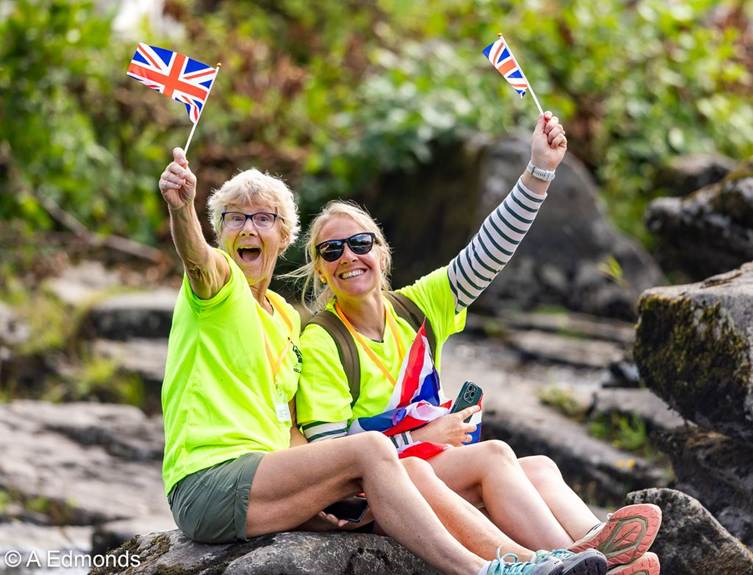
(Sally Atkinson and Louise Maloney – Volunteers – Photo by A Edmonds)
Alex Sheppy – Development Team Lead
Alex, these Championships were the lead for the Development Team, tell us about the Development Team and how many nations were represented?
The Development Team was created and funded by Paddle Europe to give talented young athletes from developing Wildwater nations the opportunity to experience an international championships environment while continuing their development on and off the water. The programme is designed to support athletes from nations that don’t yet have the same depth of coaching infrastructure or resources within Wildwater canoeing.
We brought together eight athletes from five nations – Serbia, Macedonia, Hungary, Ukraine and Romania – with all athletes competing across both kayak and canoe disciplines.
Alongside the Paddle Europe athletes, we also welcomed four GB junior athletes into the programme. It was a great opportunity for them to train alongside international paddlers, learn from an experienced coaching team and experience what it’s like to be part of a major championship. Hopefully it gives them the inspiration to keep progressing and represent Great Britain at future international championships.
Beyond the racing, the week was about learning, sharing experiences and building friendships across the sport, and it was fantastic to see that happen throughout the camp.
Managing such a large and varied group of athletes must have been a challenge. Tell us how you managed that?
It certainly looked like a big task on paper, but the reality is that it only worked because of the people around me. We had an incredible coaching and volunteer team who were all passionate about giving the athletes the best possible experience.
A special mention should go to Franziska Gawehn from Germany and Viki Scholczová from Slovakia, who brought genuine international quality to the coaching team and led the canoe development programme with a huge amount of expertise and enthusiasm. Jacob, Nick, Andrew, Laura and Ada were also invaluable throughout the week, constantly helping to solve problems as they arose and keeping everything running smoothly behind the scenes.
Alongside them, every coach and volunteer stepped up, taking ownership of different areas both on and off the water. I’d also like to thank Paddle Scotland, whose experience, local knowledge and support throughout the Championships were invaluable and helped create a fantastic learning environment for everyone involved.
The support from parents and organisers also played a huge part. It really was a team effort, and I’m incredibly grateful to everyone who gave up their time to help create such a positive experience for the athletes.
There were some notable successes for the Development Team. Can you share those with us?
We were really pleased with a number of performances across the week, but two that really stood out were Julianna Rozsa from Hungary and Blagoj Guginov from North Macedonia. Julianna reached her first major international final, finishing 14th in the Junior Women’s K1 Sprint, while Blagoj also reached his first major international final, finishing 9th in the Junior Men’s K1 Sprint.
Those performances perfectly captured what the Development Team is all about—giving young athletes the confidence, experience and support to perform on the international stage.
What I’ll remember most, though, is the atmosphere that developed over the week. Athletes from five different nations quickly became one team, learning from each other both on and off the water. One of my favourite moments was everyone teaching each other how to cheer in their own languages—whether it was “Gyerünk!” from the Hungarians or the Serbian encouragements ringing around the course. It summed up what the camp was all about: bringing people together through our sport.
Our four GB junior athletes also gained invaluable experience of a major championship environment. If everyone leaves the week more confident, inspired and motivated to keep pushing towards future international success, then I’d say the Development Team has been a real success.
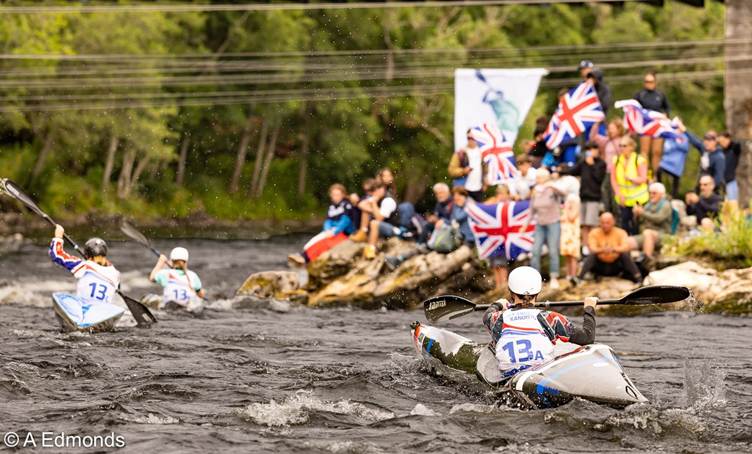
(K1W Junior team – Elsie Landsborough, Hattie McNeill, Tamsin Russel – Photo By A Edmonds)
Neil Blackman – GB Coach
Billy, you were involved in the preparation for this event, what were your expectations in the run up to racing?
Having, foolishly, been persuaded to assist with some of the pre-event planning and administration, I knew Davie and the team were en route to deliver a superb championship. As a coach I also knew we had a team of highly motivated and talented young athletes. Many of whom in my eyes, capable of winning medals. Individually they had all put in the hard hours of training and were highly prepared for the event, having spent multiple training camps at Tully over the previous 12 months. So in terms of expectations, they were exceeded on every level. From the event organisation, the overwhelming positivity from the overseas teams, but most of all the incredible spirit of the GB team athletes.
GB finished fifth overall in the medals table, how does this compare to your expectations?
As mentioned, we as a team had the best opportunity to prepare for the event. Many of the athletes had also raced in the senior team at World Cup and World Champs over the summer, and won medals. I was confident we had medal
Winning opportunities to race for, but the final medal tally surpassed my every expectation. 16 athletes shared a total of 29 medal across multiple classes. As a coach, you just can’t ask for anything better.
There has been a lot of work in the background in recent years to develop the sport, especially in the canoe classes. Without the dedication and vision of people like Nicky Cresser, Jamie Christie and Morna Campbell, to name but a few, this would not have been possible. The work of all the GB coaches and those on the committee has led to the continued upward trend in medal count over the past few years. This volunteer-led, volunteer-run support network has been key to GB WWR’s ongoing success.
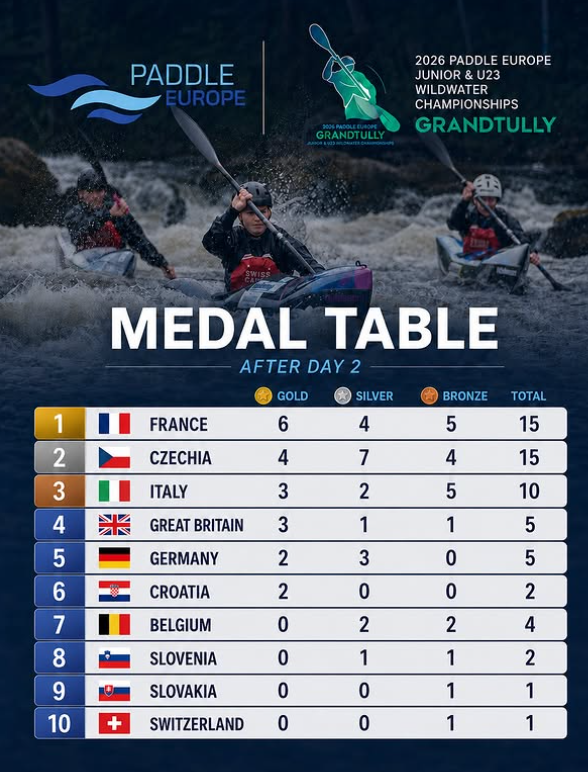
(Medal table after the second classic day by Paddle Europe)
What was the mood like in the GB Team and how did that translate to results?
Wild Water Racing, for the majority of time, for the majority of athletes is a very individual and personal discipline. However, as a group of GB team coaches and athletes we have a win-as-a-team and lose-as-a-team philosophy. We ask every athlete to help and support every other athlete in the team, whether we are winning of not. Maybe that’s with routes on the river, boat repairs, emotionally, knowledge, race planning, or being on the bank to support other classes when not racing. The mood across the team at Tully was a buzzing vibe of positivity with everyone not only focused on their own event, but also focused on everyone else to be the best they can through this huge volume of positive energy.
How did that translate to results? I think that speaks for itself!
Ross Dempster – Beyond Adventure
Ross, your team provided water safety for the event. Tell us your team’s experience of the championships
We were approached at the end of last year to run the water safety element of the race, so when we saw the first teams arriving at our base we were pretty excited!
Running safety for the Wildwater Racers was an interesting challenge for our team. We were tasked with providing comprehensive cover for the routes but also new that the standard of paddlers would generally be exceptional. We paid particular attention to the younger paddlers and development teams and came up with our safety plans based on their abilities.
Running into the event, the low water levels were our main concern, especially the entrance to Grandtully rapids looked particularly challenging and would easily pin longer boats. Although we planned for these conditions, we were lucky that the rain finally raised the water to a much friendlier level which was a relief to everyone involved!
During the race days, our team were floating in eddies without much to do a lot of the time. Although the occasional rescue punctuated every session, my main concern was that we didn’t become complacent. The BA team rose to the challenge tho and were like coiled springs throughout!
It was a fantastic event and an absolute honour to be part of a European championship. We loved seeing young people excel at something they obviously loved, it was a great atmosphere for the full 4 days.
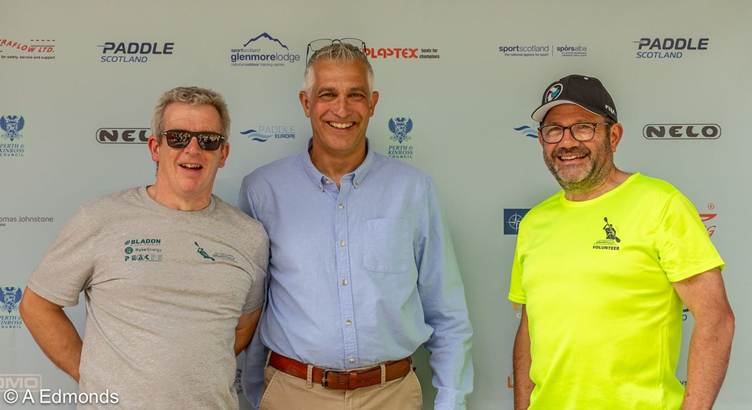
(The event organisers and officials, David Campbell (left), Paul Anderson (middle). Niall MacAleenan (right) Photo by A Edmonds)
Mike Strang – Paddle Scotland CEO
Mike, you’re new to the role of Paddle Scotland CEO. What did you think when you learned that Paddle Scotland were hosting their first international event in a generation just weeks into your role?
I was both impressed and a little overwhelmed all at once, amazed by all that had been planned and organised by a dedicated group of volunteers. I was quickly brought up to speed and realised what an amazing event this would be, welcoming young athletes from across Europe and an opportunity to welcome them to the community and environment that we are so proud of.
From a Paddle Scotland perspective, how did this event go?
The event went increadibly well and testament to the preparation and efforts of the community, supporting partners and sponsors and the collaboration and support of the local community. It was great to see the young people from 19 countries getting on so well, that atmosphere at the event was fantastic. They raced hard but also were great ambassadors for their countries, and there was great support across the international community.
Now for the big question, would you do it all again?
That is a big question, it was a great event and it went well, we also have a lot of learning from running something of that scale. It has been a fantastic boost for WWR, for Scotland and for the community who care so much about the sport. To do it all again would require the right mix of ingredients that made this event such a success, along with the support of the local community, volunteers and sponsors. The river level and sunshine also helped but a bit harder to guarantee.
Last word from Robert Knebel, Czech Team Manager
“Hello to Scotland once again. We had a wonderful week in the wild Scottish countryside. We met a very enthusiastic team of organisers. We raced on a beautiful river. We were part of a big canoeing family. We danced traditional Scottish dances.
For all this, a huge thank you to the organisers. We look forward to returning to Grandtully for another top world competition.
The organisers and the river deserve it.”
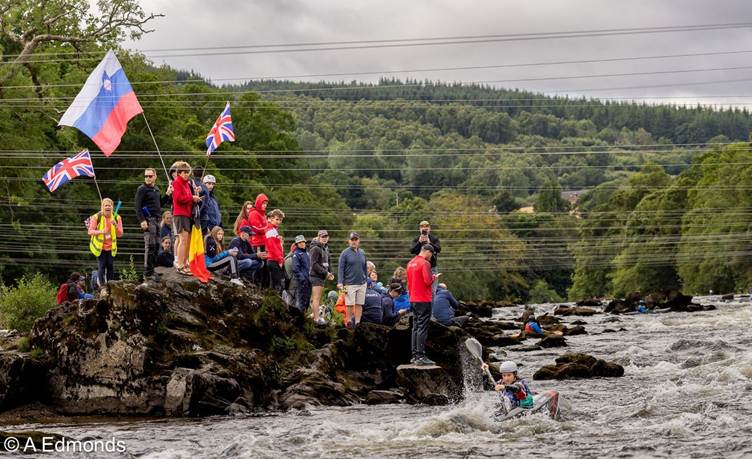
(Elsie Landsborough K1W Junior – Photo By A Edmonds)
